


HubSpot, clean and structured
Contacts, companies, deals and pipelines restructured from the ground up, or migrated cleanly if you are moving platforms. No legacy junk or mystery properties.


HubSpot rebuild
HubSpot can power sophisticated revenue operations. But without the right architecture, it restricts sales, ops and marketing. Get it right, and it becomes a true growth engine.

Most teams have a CRM and automation architecture problem, rather than a HubSpot problem. A new CRM won’t fix this, and more training won’t either. What fixes it is rebuilding the architecture around how your business actually sells.
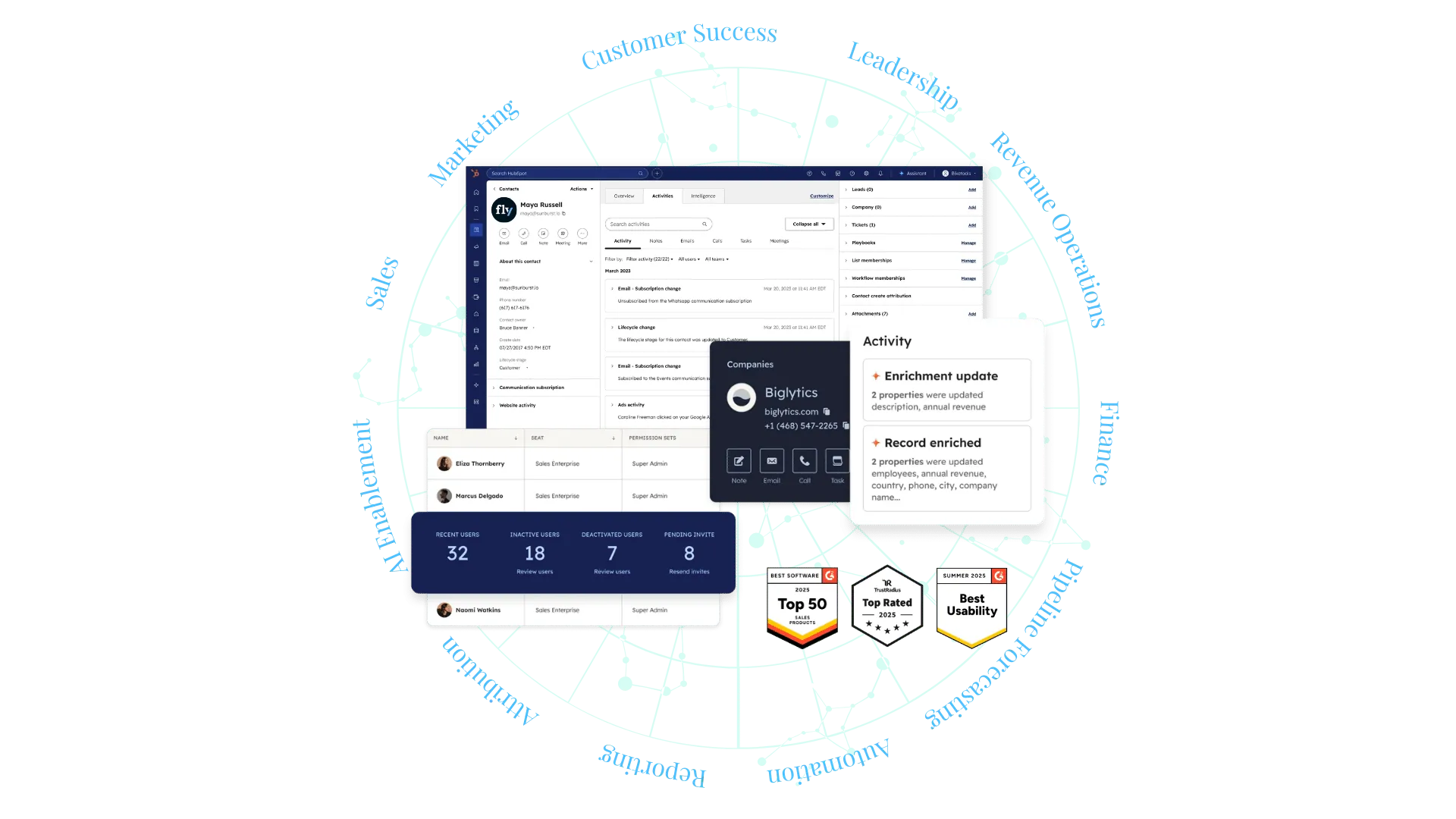
We get into your current setup properly: pipeline logic, lifecycle stages, data model, integration health, and what leadership really needs from reporting. We go beyond auditing the tool to understand how revenue moves through your business.
Where the work happens. Pipelines rationalised, properties cleaned up and lead routing configured properly. Lifecycle stages that sales and marketing both live with, and automations that live up to the name.
Dashboards built around how you sell, not around what HubSpot offers by default. Role-specific onboarding so your team understands the system they are inheriting, and a structure that is AI-ready, so forecasting and lead scoring have clean data from day one.
A HubSpot portal that supports growth needs clear architecture, clean data, aligned processes and reliable reporting. Your Flight Plan covers all of it.
Contacts, companies, deals and pipelines restructured from the ground up, or migrated cleanly if you are moving platforms. No legacy junk or mystery properties.
Sales stages, lifecycle definitions and handover points rebuilt so marketing, sales and leadership share one version of your revenue story.
Lead scoring, forecasting and content suggestions all need clean, structured data. We build the foundation so they work, now and as you scale.
Built around how your team already operates: their language, their pipeline stages, their workflows. Real-world usage wins greater adoption.
Shared lifecycle definitions, agreed handover points and one version of the pipeline that both teams live by.
Executive dashboards and funnel reporting built around your sales process, not a generic template. When leadership looks at the numbers, they trust them.
Assignment rules, alerts and lifecycle automations configured so deals move without manual nudging.
Marketing tools, analytics platforms and support systems connected cleanly, so HubSpot becomes the operational centre of your revenue operation.
Before anything goes live, your system is reviewed and tested against your actual sales process, not a checklist. If something critical can’t be implemented the way it needs to work for your team, we’ll tell you, work with you to solve it, and not launch until it’s right. What goes live, works.

Once your portal is live, you have light-touch access to our consultants for 90 days, plus a prioritised roadmap for the next improvements.
Valuable advice on the decisions that come up when a team starts using a system in reality.
The next improvements to focus on: lead generation, pipeline flow, reporting and automation maturity.
Internal projects stall because the person leading them has a day job, and a six week rebuild becomes six months. With Fly it’s scoped, delivered and done.
“Fly provided exceptional CRM consultancy and implementation services for CRIF across multiple countries.”

Glen Keller
CRIF / Credit Passport
“Fly are without a doubt, the best contemporary marketing & technology thinkers you could hope to have the good fortune to be referred to and work with.”

Gavin Keeble
SecondNature
“They integrated themselves into the right parts of our operation and delivered solid results against our objectives.”

Dan Straw
Jigsaw Cloud
“Digital marketing and marketing technology is now a competitive advantage.”

Charles Fleet
Reco Surfaces

Sales and marketing unified across the UK and Australia in one CRM.
Read case studyA cybersecurity scale-up’s revenue engine rebuilt in HubSpot in three months.
Read case study30 days is the standard. The exact shape depends on your current setup, how many integrations are in scope, and how quickly we can get the right people in the room at the start. We confirm the timeline in the diagnostic phase before any work begins.
Often not. Many clients come to us with HubSpot already in place and simply need it properly restructured and operationalised. Where a migration makes sense, we manage it. Either way, the outcome is the same: HubSpot built so your team uses it.
When rollouts fail it is usually because the system is built around platform features rather than how teams really work. We start with how your team operates, then structure HubSpot around those processes, with role-based onboarding so admins, managers and sellers know exactly how to use it day to day.
We don’t lead with large-scale data cleansing. We help you decide what matters, map it correctly into the rebuilt structure, and make sure the records that drive your pipeline are clean and usable. That is usually more valuable than scrubbing everything.
Less than you’d expect. We need access to your systems, time with the right people to understand your sales process, and occasional sign-offs. We handle the architecture, configuration and rollout. You review, approve and launch.
We build the system around how your team already operates, not how a consultant thinks they should. Role-specific training for admins and power users is part of every engagement, so it becomes part of the daily workflow.
Most environments include marketing tools, analytics platforms, support systems and finance software. We make sure they work cleanly with the rest of your stack, so HubSpot becomes the operational engine of your revenue system, not another disconnected tool.
We thoroughly review and test your system before anything goes live. If an issue appears after launch, we work with you to resolve it quickly. Our goal is a system that is stable, usable and trusted by your team from day one.
If your team regularly works around HubSpot with spreadsheets, external trackers or ignored dashboards, that is usually an architecture problem, not a surface-level configuration issue. We will tell you honestly in the diagnostic phase what is needed and what isn’t.